Uniswap vs PancakeSwap Volume: Who Really Leads?
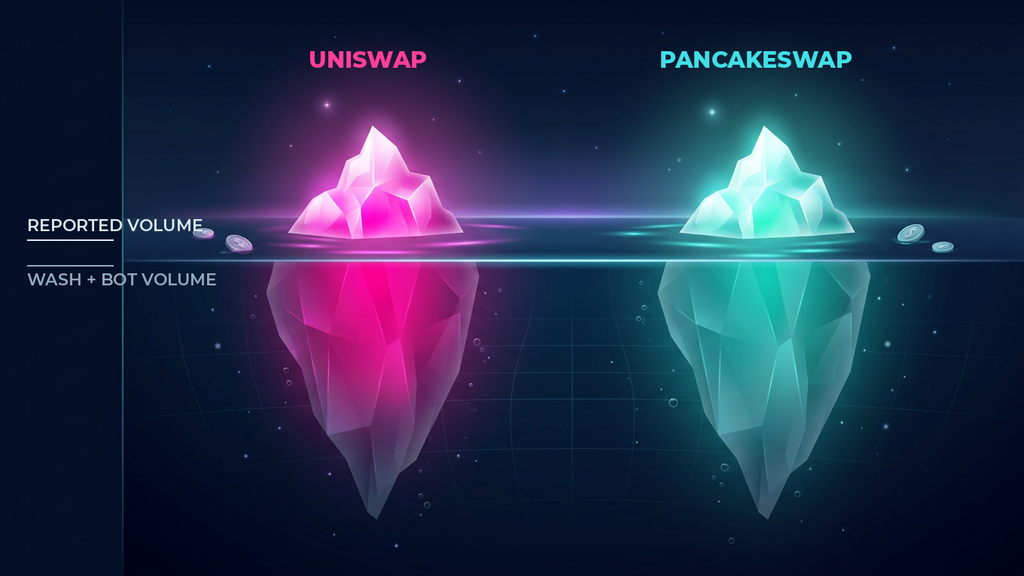
Uniswap vs. PancakeSwap: Which DEX Actually Has More Volume in 2026?
Anyone comparing Uniswap vs PancakeSwap volume in 2026 will find two very different answers depending on which week they check. Headlines from late 2025 claimed PancakeSwap had overtaken Uniswap. Other reports from Q1 2026 said the opposite. Both can be technically correct, because DEX volume swings hard from week to week. This piece cuts through the noise using current DefiLlama data and explains why the rankings keep flipping.
Trading volume tells you which exchange traders are actually using right now, not just which one has the flashiest marketing. It also affects slippage, liquidity depth, and how easily you can execute a large trade without moving the price. For anyone deciding where to swap tokens, that distinction matters more than a headline.
Uniswap vs PancakeSwap Volume: The Current Numbers
According to DefiLlama, Uniswap processed $81.3 billion in DEX volume over the trailing 30 days, against PancakeSwap’s $30.6 billion. That gap holds across every timeframe. Over the past seven days, Uniswap did $21.8 billion in swaps, while PancakeSwap did $5.9 billion. In the last 24 hours alone, Uniswap moved $2.8 billion versus PancakeSwap’s $795 million.
Zoom out further and the pattern stays consistent. Uniswap’s cumulative, all-time DEX volume sits at $3.885 trillion. PancakeSwap’s lifetime total is $2.099 trillion. Uniswap therefore processes roughly 2.6 times more volume than PancakeSwap right now. That is a decisive lead, not a coin-flip.
However, this snapshot hides an important nuance. Weekly DEX volume can shift dramatically during memecoin rallies, new chain launches, or sudden airdrop farming activity. As a result, a single bad week for Uniswap or a single great week for PancakeSwap can temporarily flip the leaderboard, even while the 30-day trend stays unchanged.
Why the “PancakeSwap Overtook Uniswap” Headlines Keep Coming Back
Back in March 2025, PancakeSwap posted over $14 billion in weekly volume, a 58% jump that briefly pushed it past Uniswap in that specific seven-day window. Crypto media ran with it, and the story stuck around long after the numbers normalized. Something similar happened again in parts of 2025, when PancakeSwap’s annual volume figure edged ahead of Uniswap’s for a stretch tied to BNB Chain memecoin trading.
Because of this pattern, it helps to separate two very different questions: “who won last week” and “who leads structurally.” PancakeSwap’s spikes tend to correlate with retail speculation cycles on BNB Chain. Uniswap’s baseline, meanwhile, comes from deeper, more consistent liquidity across Ethereum and its Layer 2 networks. Neither number is wrong. They just measure different things.
Meanwhile, a broader shift has been reshaping the whole DEX category. CoinGecko’s 2026 CEX & DEX Trading Activity Report found that both PancakeSwap and Uniswap climbed into the top 10 crypto exchanges by cumulative volume between August 2025 and January 2026, spot markets included. DEX share of total spot trading volume doubled to 13.6% in that window. That trend matters more than any single weekly spike, and we cover it in more depth in our breakdown of why DEX market share has been climbing against centralized platforms.
What’s Actually Driving Uniswap’s Volume Lead
Uniswap’s current advantage in the Uniswap vs PancakeSwap volume comparison comes from three factors working together.
First, Uniswap now operates across 49 chains, and its liquidity no longer depends on Ethereum mainnet alone. Base, Arbitrum, and Polygon each contribute billions in monthly volume. Interestingly, Robinhood Chain has quietly become Uniswap’s single largest volume source, processing $31.8 billion over the past 30 days versus Ethereum’s $25 billion. That single integration reshaped where Uniswap’s volume actually comes from.
Second, the UNIfication governance update, rolled out on November 10, 2025, redirected a share of protocol fees toward UNI buybacks and burns. This gave traders and liquidity providers a stronger reason to stick with Uniswap pools instead of migrating elsewhere. Token Terminal data shows Uniswap processed roughly $1.1 trillion in trading volume over its trailing 365 days, with its largest single month hitting $116.6 billion in October 2025.
Third, Uniswap’s concentrated liquidity model across V3 and V4 pools improves capital efficiency for large trades. Bigger swaps route through Uniswap more often because slippage stays lower. This effect compounds: more volume attracts more liquidity, and more liquidity attracts even more volume.
PancakeSwap’s Real Strength Isn’t Pure Volume
PancakeSwap still wins on a different metric: user count and product breadth. It processes 5.36 million daily transactions from 414,202 active addresses, both respectable figures against Uniswap’s 8.43 million transactions and 507,975 addresses. Because BNB Chain fees run far lower than Ethereum mainnet gas costs, PancakeSwap attracts smaller, more frequent trades rather than fewer large ones.
PancakeSwap has also expanded well past simple token swaps. It now bundles yield farms, single-asset staking through Syrup Pools, a lottery, an NFT marketplace, and prediction markets into one platform. Traders looking for a full DeFi hub rather than a pure swap tool tend to gravitate here. That breadth explains why PancakeSwap’s total value locked of $2.27 billion punches well above what its volume alone would suggest.
Uniswap vs PancakeSwap Volume by Chain
Breaking the numbers down by chain reveals just how differently each platform is structured.
Uniswap’s 30-day volume splits across Robinhood Chain ($31.8B), Ethereum ($25.0B), Base ($7.7B), BSC ($5.9B), and Arbitrum ($5.1B), with dozens of smaller chains making up the rest. In other words, no single chain accounts for even 40% of Uniswap’s total activity anymore.
PancakeSwap tells the opposite story. BSC alone accounts for $25.4 billion of its $30.6 billion in 30-day volume, or about 97% of everything the platform processes. Base contributes a distant second at $3.8 billion, and every other chain barely registers by comparison. This concentration is not necessarily a weakness, but it does mean PancakeSwap’s fortunes rise and fall with BNB Chain activity specifically.
Fees, Liquidity, and User Activity Compared
Volume alone doesn’t capture the full financial picture. Uniswap generated $190.7 million in fees over the past 30 days and converted $15.6 million of that into protocol revenue. PancakeSwap generated $23.0 million in fees and $7.5 million in revenue over the same period. Uniswap earns more in absolute terms, but PancakeSwap actually converts a higher percentage of fees into protocol revenue, thanks to its buy-back-and-burn mechanics for the CAKE token.
Total value locked tells a similar story of scale. Uniswap holds $3.6 billion in TVL, up 22.8% over the past month. PancakeSwap holds $2.27 billion, up a more modest 2.3%. Because TVL and volume both grew for Uniswap simultaneously, that combination signals genuine, sustained demand rather than a short-lived spike.
Governance token performance adds one more data point. UNI trades at $7.78 and is up 130.9% over the past 30 days, largely on enthusiasm around the fee-switch rollout and a reported BlackRock investment round in February 2026. CAKE trades at $2.45, up 59.1% over the same window. Both tokens remain far below their 2021 all-time highs, so neither should be treated as a low-risk asset regardless of which platform wins the volume race.
Which DEX Should US Traders Actually Use in 2026?
For traders who mostly work with ETH, USDC, or other Ethereum-native assets, Uniswap remains the deeper, more liquid choice. Its concentrated liquidity pools reduce slippage on larger trades, and its Layer 2 expansion keeps gas costs manageable. Traders who need to move six-figure positions without moving the market will generally get a better execution price here.
For traders working primarily with BNB Chain assets, smaller trade sizes, or anyone who wants farming and prediction markets alongside basic swaps, PancakeSwap remains the more cost-effective and feature-rich option. Its lower fee structure makes frequent small trades far less punishing than they would be on Ethereum mainnet.
It’s also worth noting that both platforms increasingly compete not just with each other, but with the broader shift toward on-chain trading generally. As we noted in our recent look at how decentralized platforms have been breaking into the top 10 crypto exchanges, the real long-term story may not be Uniswap versus PancakeSwap at all — it may be DEXs collectively taking share away from centralized exchanges. According to the DefiLlama DEX volume tracker, the two platforms combined moved over $110 billion in the past month alone, a figure that would have seemed unthinkable just a few years ago. For broader context on how US regulators are approaching this shift, the CFTC’s digital asset resource hub offers a useful primary reference.
Ultimately, choosing between Uniswap and PancakeSwap depends less on raw volume and more on which chain your assets already live on. Volume matters mainly as a proxy for liquidity depth, and by that measure, Uniswap currently holds a clear structural lead. Still, DEX rankings move fast, and any comparison written today deserves a re-check in three months.
FAQ
Does PancakeSwap ever beat Uniswap in weekly volume?
Yes, periodically. PancakeSwap posted a week with over $14 billion in volume in March 2025, briefly surpassing Uniswap during a BNB Chain memecoin surge. These spikes happen but rarely hold for more than a few weeks.
Which DEX has lower fees?
PancakeSwap generally offers lower transaction costs because it runs primarily on BNB Chain, which has significantly cheaper gas fees than Ethereum mainnet. Uniswap’s Layer 2 deployments on Base and Arbitrum have narrowed that gap considerably.
Is Uniswap or PancakeSwap safer to use?
Both are established, audited protocols with years of track record. Uniswap has one recorded security incident from 2020, before its current smart contract versions existed. PancakeSwap has no comparable public incident on record with DefiLlama. Neither platform is immune to smart contract or market risk, and neither should be treated as regulated financial infrastructure.
Which token has performed better, UNI or CAKE?
Over the past 30 days, UNI gained 130.9% while CAKE gained 59.1%. Both remain more than 80% below their 2021 all-time highs, so recent gains don’t erase long-term volatility.