1099-DA Cost Basis: Why Transferred Crypto Shows Blank
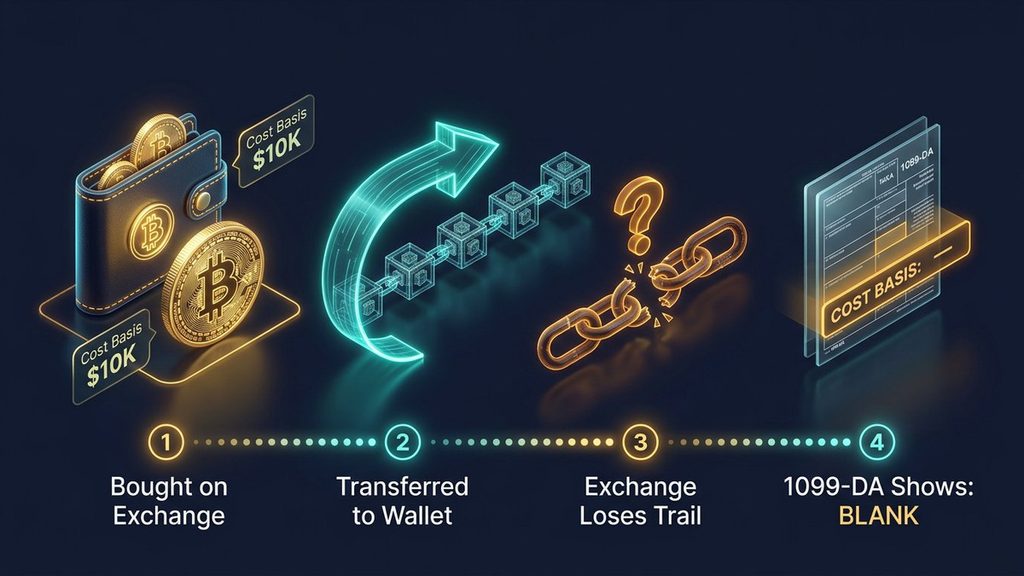
If you bought crypto on one exchange and sold it on another this year, expect a blank box on your next tax form. The 1099-DA cost basis column will likely be empty for those coins, even though 2026 is the first year brokers must report basis. However, that is not a glitch. Instead, it is how the IRS rules were written.
Here is the short version. To put it simply, basis reporting only applies to “covered” coins. In other words, a coin stops being covered the moment it leaves the exchange where you bought it. Below, we walk through which of your trades will show basis, which won’t, and what to do before December 31.
What changes on the 2026 Form 1099-DA
The first round of Form 1099-DA arrived in early 2026 for 2025 sales. However, those forms showed gross proceeds only. Basis was optional, and most exchanges skipped it.
By contrast, the forms you receive in early 2027 are different. For sales after 2025, brokers must report proceeds for every digital asset. In addition, they must report basis for coins that qualify as covered securities. For everything else, basis stays voluntary.
That split matters more than most people expect. For example, many traders assume the 2027 form will finally do the math for them. In practice, active users of more than one platform will get a mix of complete and incomplete lines.
Which coins are covered, and why your 1099-DA cost basis disappears
The 2026 Instructions for Form 1099-DA define a covered security narrowly. It must meet two tests:
- You acquired it after 2025, in an account where the broker held it for you.
- It stayed in that same account until the broker sold it.
Otherwise, the coin is noncovered. Specifically, the IRS lists several noncovered cases. Three of them catch most retail traders:
- Coins acquired before January 1, 2026.
- Anything transferred in from another exchange or a self-custody wallet.
- Coins the broker did not hold in custody when you acquired them.
The second bullet is the trap. Say you buy ETH on Exchange A in March 2026. You move it to Exchange B in June and sell it in October. However, Exchange B never saw your purchase. As a result, it treats the coins as noncovered and has no duty to report your basis.
Moreover, the rules offer no bridge here. Under the current final regulations, a transfer into a broker’s custody breaks the chain. Consequently, no statement from the old exchange carries your basis to the new one.
What a noncovered line looks like on the form
In practice, a noncovered sale is easy to spot once you know the boxes. Here is what each one tells you:
| Box | What it shows | What it means for a transferred coin |
|---|---|---|
| 1f | Proceeds, net of fees | Always filled in |
| 1d | Date acquired | Often blank |
| 1g | Cost or other basis | Often blank |
| 2 | Basis reported to IRS | Usually unchecked |
| 9 | Noncovered security | Checked by most exchanges |
| 12a | Units transferred in | Number of units that arrived from elsewhere |
| 12b | Transfer-in date | The day the coins landed, not the day you bought them |
Boxes 12a and 12b are new and genuinely useful. Specifically, they show which units arrived from outside. Because of this, you can match each sale to the right purchase record on your old platform.
One warning on box 1g. The instructions tell brokers to enter zero only when your basis truly is zero. In other words, a blank box means “not reported,” not “zero.” However, if you leave it blank on your return too, you report proceeds with no offsetting cost. That overstates your gain.
The transfer date problem nobody mentions
There is a second, quieter issue. Above all, it affects which coins the exchange says you sold.
When you sell part of a position, the broker follows your lot instructions. Otherwise, it generally sells the earliest units first. Meanwhile, transferred coins get a default date. If the broker does not use your own purchase records, it treats transferred units as acquired on the date and time they arrived.
Picture a trader who bought BTC on Exchange A in 2024. She moves it to Exchange B in May 2026. She also buys fresh BTC on Exchange B in February 2026. In the broker’s eyes, the February lot is older than the transferred lot. So a partial sale in November may draw from the February coins first.
As a result, that ordering changes your holding period and your gain. Furthermore, the instructions add one more limit. Brokers may use customer-provided acquisition data to pick lots, but not to report basis or dates. In short, telling your exchange when you really bought something will not fill in box 1g.
Worked example: one trader, two exchanges
The numbers below are hypothetical, chosen to show the mechanics. They are not a market forecast.
Marcus buys 2 ETH on Exchange A in February 2026 for $5,000. In March, he buys 1 ETH directly on Exchange B for $3,000. In July, he moves his 2 ETH from A to B. In November, he sells all 3 ETH on Exchange B for $10,500, after fees.
Here is how his early-2027 form would likely look:
| Lot | Acquired | Status | Box 1f | Box 1g | Box 9 |
|---|---|---|---|---|---|
| 1 ETH bought on B | March 2026 | Covered, short-term | $3,500 | $3,000 | Unchecked |
| 2 ETH moved from A | February 2026, on A | Noncovered | $7,000 | Blank | Checked |
Also, the broker files these on separate forms. The instructions require it: covered short-term, covered long-term and noncovered sales each get their own Form 1099-DA.
Now look at the tax effect. On the first line, the gain is $500, and the form already shows it. On the second line, the real gain is $2,000 ($7,000 minus $5,000). If Marcus copies the form blindly, he reports $7,000 of gain instead of $2,000. That is $5,000 of phantom gain, taxed at his short-term rate.
The fix is simple, but it requires records. Marcus needs his Exchange A purchase history and his transfer receipt. Then he enters the $5,000 basis himself on Form 8949.
How to report a blank 1099-DA cost basis on Form 8949
Your form includes a one-letter code that maps each line to Form 8949. The 1099-DA instructions define it like this:
| Code | Holding period | Basis reported to IRS? |
|---|---|---|
| G | Short-term | Yes |
| H | Short-term | No |
| J | Long-term | Yes |
| K | Long-term | No |
| Y | Unknown | No, holding period unclear |
In most cases, transferred coins land under H or K. For those lines, you enter the proceeds from box 1f and your own basis. Then you work out the gain or loss.
Code Y deserves attention. The broker uses it when it cannot tell whether your gain is short- or long-term. In fact, with transferred coins, that is common. You decide the holding period from your original purchase date, not the transfer-in date in box 12b.
Finally, keep your evidence. After all, the IRS compares the proceeds on your return with what brokers report. If your basis is higher than zero, you should be able to show where that number came from.
Five common situations at a glance
Most readers fit one of these patterns. Find yours to see what your form should show.
| Your situation | Status at the selling exchange | Will basis appear? | What you need |
|---|---|---|---|
| Bought and sold on the same exchange, all in 2026 | Covered | Yes | Just check the numbers |
| Held since 2024 or 2025, sold in 2026 on the same exchange | Noncovered | Maybe, if the exchange reports it voluntarily | Your purchase history |
| Bought on Exchange A in 2026, sold on Exchange B | Transferred in, so noncovered | Usually not | Exchange A records and transfer receipt |
| Purchased on a DEX, moved to an exchange, sold there | Noncovered | No | Wallet history and on-chain transaction IDs |
| Traded only in a self-custody wallet | Not reported on a 1099-DA | No form at all | Your own complete records |
The second row surprises people. Indeed, coins you held before 2026 never become covered, even if you never moved them. Some exchanges may still fill in the basis voluntarily. However, they will usually check box 9, and the IRS does not penalize them for errors in that voluntary data.
What to download from your old exchange this month
Simply put, records are the whole game here. Once an account closes, getting your history back can take weeks of support tickets. In some cases, it never comes back at all.
Before the end of the year, save these files from every platform you used:
- Full trade history from the day you opened the account, not just 2026.
- Deposit and withdrawal history, including network, wallet address and transaction ID.
- Fee records, because fees change both your proceeds and your basis.
- Any 2025 Form 1099-DA the platform issued, plus corrected versions.
- Account statements that show your balance on December 31, 2025.
In addition, keep the files in two formats. A CSV lets crypto tax software rebuild your basis. A PDF gives you a readable copy if the IRS ever asks how you got your numbers.
With those files, you can rebuild the missing 1099-DA cost basis for each transferred lot. Without them, you would have to reconstruct prices from public market data. That works in a pinch, but it is slower and harder to defend.
If the old exchange already shut down
This happens more than people think. Platforms exit the US market, merge or fail. If you cannot reach your old records, you still have options.
First, search your email. Most exchanges send trade confirmations and withdrawal notices. Those messages often include the price, amount and date. Next, check the blockchain. A withdrawal leaves a public transaction ID, and that proves the transfer date and amount.
From there, you can estimate basis using the market price on the purchase date. Document every source you use. If the IRS questions the figure, a clear, consistent method carries real weight. A number with no paper trail does not.
Your decision tree before December 31
Of course, not every situation needs action. Use this sequence to decide:
- Did you sell anything in 2026 that you moved between platforms? If not, your 1099-DA cost basis should look complete for 2026 purchases. Skip to step 4.
- Do you still have the purchase history from the original platform? If yes, download it now as a CSV and a PDF. Exchanges change export tools and close accounts without much notice.
- Did the coins come from a self-custody wallet? Then you need your wallet records and the on-chain transfer. A DEX swap never appears on a 1099-DA, so your own records are the only source. We cover why in our guide on cutting gas fees on DEX platforms, where we look at how on-chain trades work.
- Will you sell again in 2027? If you can, buy on the platform where you plan to sell. Coins bought and sold in the same custodial account keep their covered status.
- Do you sell partial positions? Then ask your exchange how to set standing lot instructions. Otherwise, the transfer-date ordering above may decide which units you sold.
Common mistakes we expect to see in 2027
We have read through a lot of first-year 1099-DA questions. In particular, four errors come up again and again.
- Treating a blank basis box as zero. It is not zero. It is missing.
- Using the transfer-in date as the purchase date. Box 12b records when coins arrived, not when you bought them. Using it can flip a long-term gain into a short-term one.
- Consolidating everything onto one exchange in December. Moving coins now makes them noncovered at the new platform. It tidies your app, but it can hurt your 2027 form.
- Assuming the form covers all your activity. Staking rewards are excluded from Form 1099-DA. Wrapping, liquidity provision and crypto lending are also outside broker reporting for now under IRS Notice 2024-57. You still owe tax on any income or gain they produce.
Our take: is this a design flaw or a feature?
Honestly, a bit of both. For instance, stock brokers spent years building transfer statements so basis follows your shares. In contrast, crypto exchanges do not have an equivalent system yet. The IRS chose not to make one exchange vouch for another’s numbers.
From a compliance angle, that caution makes sense. Exchange A’s records may be wrong, and Exchange B cannot check them. For traders, though, the result is a form that looks official but tells half the story.
Our practical advice: treat the 2026 form as a proceeds report, not a tax calculation. Build your own cost basis file and reconcile it against every form you receive. If you also make quarterly payments, our crypto estimated taxes calendar explains how to budget for gains during the year.
Because the rules are still settling, check the IRS page for Form 1099-DA updates before you file. The figures and form details here reflect the instructions published in February 2026.
This article is for general information only and is not tax advice. For your situation, talk to a CPA or enrolled agent.
FAQ
Will my 2026 Form 1099-DA show cost basis?
Only for covered coins: those bought after 2025 and sold from the same custodial account. For coins bought earlier or transferred in, basis reporting is voluntary, so the box may be blank.
Why is the cost basis blank on my 1099-DA?
Usually because the coins are noncovered. Box 9 will be checked. You must supply the basis yourself on Form 8949.
Does moving crypto between exchanges reset the cost basis?
No. Your real basis stays the same for tax purposes. What changes is reporting: the new exchange treats the coins as noncovered and does not have to report what you paid.
What do boxes 12a and 12b mean on Form 1099-DA?
Box 12a shows how many units were transferred into the account. Box 12b shows the transfer-in date. Neither is your purchase date.
What if my exchange reports the wrong basis?
Report the correct figure on Form 8949 and keep your records. Ask the exchange for a corrected form if the error is on a covered line.