Hyperliquid Explained: How the Hybrid Exchange Works
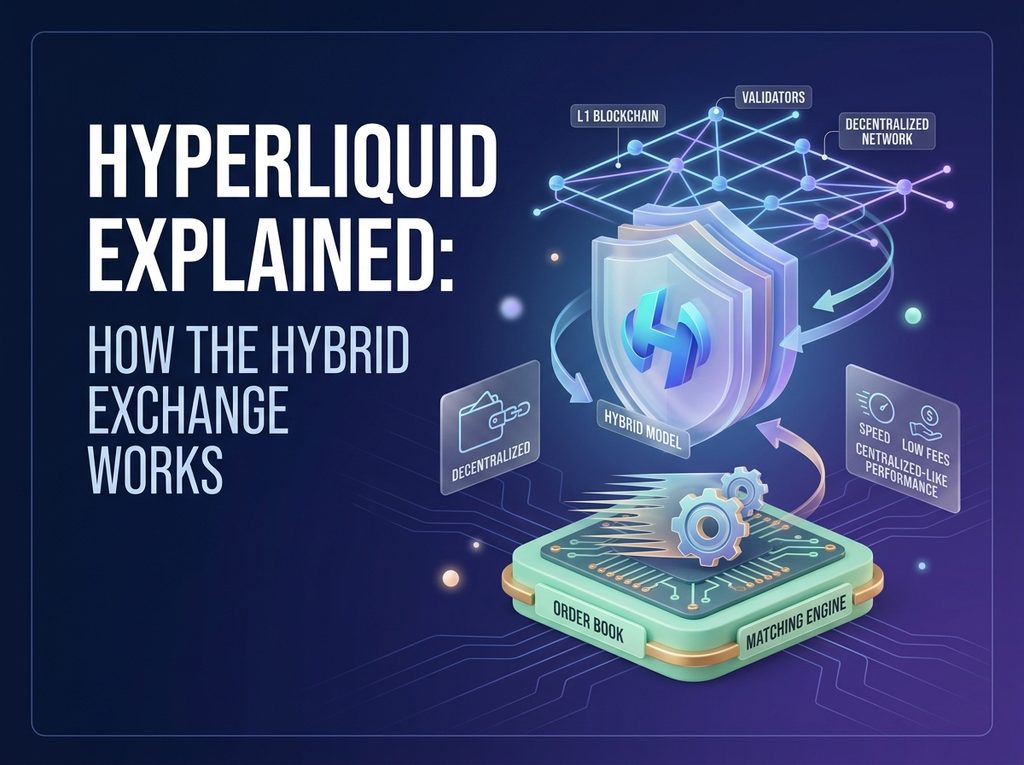
Most crypto platforms force you to pick a side. A centralized exchange gives you speed and a familiar order book, but a company holds your funds. A decentralized exchange gives you self-custody instead. However, that usually costs you speed and the trading tools serious traders expect. Hyperliquid explained simply is this: it refuses to pick a side. That refusal has made it the largest venue for on-chain perpetual futures trading anywhere in the market.
This guide breaks down exactly how Hyperliquid works under the hood. It also covers why its hybrid design matters, and what the numbers behind its growth actually tell you as a trader.
What Makes Hyperliquid Different From a Typical DEX
Most decentralized exchanges are applications built on top of someone else’s blockchain, like Ethereum or Solana. Hyperliquid took a different path entirely. It built its own purpose-built Layer 1 blockchain specifically to host its own exchange. In other words, Hyperliquid isn’t just an app running on a chain. It is the chain.
This distinction matters for one key reason. It lets Hyperliquid run a fully on-chain central limit order book. That’s the same matching system traditional exchanges like Coinbase or Kraken use. Most DEXs rely on a different model instead, called an automated market maker. Hyperliquid’s blockchain records every order, cancellation, trade, and liquidation directly and publicly. Most exchanges match trades off-chain on a private server instead.
The Three-Layer Architecture Behind Hyperliquid
To understand Hyperliquid explained properly, break its design into three distinct layers. Each layer handles a different job.
The first layer is called HyperBFT. It handles consensus, meaning it gets every computer on the network to agree on the correct transaction order. HyperBFT is a custom variant of a well-established algorithm called HotStuff. Engineers tuned it specifically for low latency and high throughput. It requires signatures from more than two-thirds of the network’s staked tokens to finalize a block. It does this remarkably fast, too. Finality takes roughly 0.2 seconds. For context, that’s fast enough to feel closer to a centralized exchange than to a typical blockchain transaction.
The second layer is HyperCore, the actual trading engine. This is where the central limit order book lives. It processes spot and perpetual futures markets, handling bids, asks, and executed trades as native blockchain logic. Most DEXs bolt trading on as a smart contract instead. Because the matching engine runs as core protocol logic, Hyperliquid processes over 100,000 operations per second. A smart contract on a general-purpose chain would struggle to hit that scale.
The third layer is HyperEVM. It provides an Ethereum-compatible environment for developers building on top of Hyperliquid. This layer remains in a relatively early rollout stage as of 2026. It lets the ecosystem expand beyond trading alone. Developers can build lending platforms, vaults, and other DeFi products here. These products can read data directly from HyperCore’s order book state.
How Fees and the HYPE Token Actually Work
Trading on Hyperliquid costs a maker fee of 0.01% and a taker fee of 0.035%. That’s notably low, especially once you factor in something else. These trading fees are the only costs involved. Most DEXs charge a separate blockchain gas fee on top of every trade. Hyperliquid doesn’t. Gas fees only apply to HyperEVM smart contract interactions, a meaningfully different cost structure than the typical DEX experience we cover in our broader guide to smart contract risks and how to avoid them.
The platform’s native token, HYPE, has a maximum supply of 1 billion tokens. Roughly 220 to 250 million currently circulate. HYPE serves three core functions: securing the network through staking, enabling governance votes, and paying HyperEVM gas fees. Its economics stand out for one specific reason: a buyback-and-burn mechanism. Trading fee revenue automatically buys back HYPE tokens on the open market, often above 97% of total revenue. The protocol then burns those tokens permanently. This creates a direct link between trading activity and token scarcity. More trading means less HYPE in circulation over time.
The Numbers That Explain Why This Matters
Hyperliquid now clears more than $180 billion in perpetual futures volume every month. That’s more than every other on-chain trading venue combined. In the second quarter of 2026, Hyperliquid reclaimed its lead in the perpetual DEX category. It captured a 37% market share, rebounding sharply from a low near 17% just months earlier. The HYPE token peaked above $76 in June 2026. That pushed its market capitalization above $12 billion, placing it among the ten largest cryptocurrencies by that measure.
Traditional finance has taken notice too. Asset manager Bitwise launched a spot Hyperliquid ETF in the United States in May 2026, under the ticker BHYP. The product notably features in-house staking. This sends a clear signal: institutional players now view Hyperliquid as legitimate infrastructure worth building regulated products around. Corporate treasuries have reportedly started accumulating HYPE tokens directly too, following a pattern already seen with Bitcoin and Ethereum treasury strategies.
Builder-Deployed Markets and What’s Coming Next
One feature sets Hyperliquid apart from a typical exchange. A system called HIP-3 lets third-party developers launch entirely new perpetual markets on top of Hyperliquid’s existing infrastructure. They don’t need to wait for the platform itself to list a new asset. This effectively turns market creation into a permissionless, community-driven process. A centralized listing decision no longer gates new markets.
Looking ahead, a 2026 upgrade called HIP-4 introduces fully collateralized prediction markets and event-based hedging products. These new products come without the liquidation risk that leveraged perpetual futures carry. This is a genuinely notable development. It positions Hyperliquid to compete directly in the prediction markets space, a fast-growing category we’ve flagged as worth watching in our broader coverage of the crypto exchange landscape heading into 2027.
What “Hybrid” Actually Means Here
Calling Hyperliquid a hybrid exchange isn’t just marketing language. It reflects a genuine architectural choice. Hyperliquid combines centralized-exchange-grade execution speed and order book depth with the self-custody and transparency of a decentralized exchange. Users never hand custody of their funds to a company the way they would on Coinbase or Kraken. Every trade settles directly on-chain through their own wallet instead. At the same time, the trading experience feels far closer to a top-tier centralized platform than to a typical AMM-based DEX like Uniswap. Order types and execution speed both reflect that.
Industry analysts have pointed to exactly this model as “the most likely path forward” for the broader CEX vs. DEX debate. It resolves the core trade-off that’s defined the space for years. Traders no longer have to choose between speed and control.
How Hyperliquid Compares to Other Perpetual DEX Platforms
Hyperliquid isn’t the only platform competing in on-chain perpetual futures. It currently leads by a wide margin, though. We cover the broader field of competing platforms in our guide to the best perpetual DEX platforms in 2026, including how they differ in fees, supported assets, and architecture. If you’re weighing whether a fully on-chain venue like Hyperliquid fits your trading style better than a centralized exchange, our broader comparison of CEX vs. DEX covers the fundamental trade-offs in more depth.
Risks Worth Understanding Before You Trade
Self-custody cuts both ways. You control your own funds directly, which removes the exchange custody risk we cover in our guide to what changed after the FTX collapse. However, it also means no customer support line exists to call if you make a transaction error. In addition, Hyperliquid relies heavily on a single, purpose-built Layer 1 blockchain. This concentrates risk differently than a DEX built on a widely used chain like Ethereum. If Hyperliquid’s own infrastructure runs into an issue, no broader ecosystem exists to fall back on. A more general-purpose chain might offer that safety net; Hyperliquid doesn’t. Perpetual futures trading itself also carries substantial leverage risk, regardless of which platform you use. Take that risk seriously before committing real capital.
The Bottom Line
Hyperliquid explained at its core is a bet: traders shouldn’t have to choose between speed and self-custody. The market’s response so far strongly validates that bet. Hyperliquid built its own blockchain specifically to host a fully on-chain order book. As a result, it delivers execution quality that rivals centralized exchanges while keeping funds in traders’ own hands the entire time. With over $180 billion in monthly volume, a genuinely novel deflationary token model, and now a regulated US ETF built around it, Hyperliquid has moved well past the experimental phase. It has become infrastructure the rest of the industry now actively builds around. For the platform’s own technical documentation, see Hyperliquid’s official developer documentation.
FAQs
Is Hyperliquid a centralized or decentralized exchange?
Hyperliquid is decentralized. Users retain full self-custody of their funds, and every trade settles directly on Hyperliquid’s own blockchain rather than through a company holding customer deposits.
What is the HYPE token used for?
HYPE is used for staking to help secure the network, voting on governance proposals, and paying gas fees on Hyperliquid’s smart contract layer, HyperEVM. Most trading fee revenue also goes toward buying back and burning HYPE tokens.
How fast is Hyperliquid compared to a traditional exchange?
Hyperliquid achieves transaction finality in roughly 0.2 seconds and can process over 100,000 operations per second, performance comparable to many centralized exchanges.
Is there an ETF for Hyperliquid?
Yes. Asset manager Bitwise launched a spot Hyperliquid ETF in the United States in May 2026 under the ticker BHYP, which includes in-house staking as part of the product.