Is It Safe to Keep Crypto on an Exchange? FTX Lessons
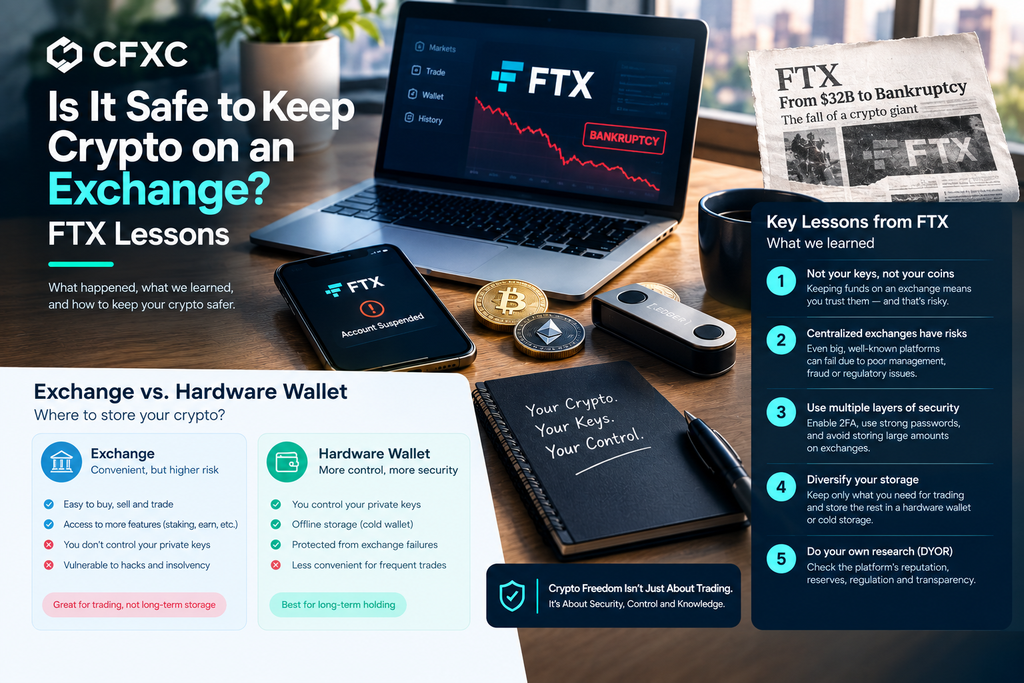
Every crypto beginner eventually asks the same question: is it safe to keep crypto on an exchange? The honest answer depends entirely on which exchange. In fact, the collapse of FTX in November 2022 remains the clearest case study in exactly what can go wrong. This guide breaks down what actually happened, what’s changed in the industry since then, and what it genuinely means for your funds today.
What Actually Happened at FTX
FTX, once one of the largest crypto exchanges in the world, collapsed in November 2022. At that point, investigators discovered that the company had secretly transferred customer funds to Alameda Research, a trading firm also controlled by founder Sam Bankman-Fried. When customers rushed to withdraw their money, the exchange simply didn’t have it. As a result, FTX had used billions of dollars in customer deposits elsewhere without authorization.
A jury later convicted Bankman-Fried on seven counts of fraud and conspiracy. Because of this, a judge sentenced him to 25 years in prison, along with an $11.02 billion forfeiture order. As of September 2026, he’s still fighting that outcome. He has petitioned the US Supreme Court to overturn his conviction after losing an appeal earlier in the year. For the official record of the case, see the Department of Justice’s press release on the sentencing.
Here’s the Twist Most People Don’t Know: Creditors Are Getting Paid Back
This is the part of the story that changed significantly after the initial collapse. Specifically, the FTX Recovery Trust has distributed billions of dollars back to customers since 2025. By mid-2026, several claim classes had reached full recovery. Some even received more than 100% of their original claim value.
However, there’s a crucial catch that reveals a real lesson about exchange risk. The trust calculates repayments using crypto prices from November 11, 2022, the day FTX filed for bankruptcy, and pays them out in US dollars. Because of this, a customer whose Bitcoin was worth $17,000 at the time of the collapse gets repaid based on that $17,000 value. Bitcoin has since traded well above $90,000. In other words, even a “successful” recovery from an exchange failure can mean missing out on years of gains you would have kept if you’d held your crypto yourself.
The Real Lesson: It’s Not Just About Losing Money
Losing access to your funds for years, even if you eventually get most of it back, is itself a massive cost. For example, customers couldn’t touch their money throughout the entire bankruptcy process. Full resolution took years to reach. So, “safe” isn’t just about whether an exchange eventually returns your funds. Instead, it’s also about whether you can access them when you actually need to.
What Changed in the Industry After FTX
The collapse forced a genuine shift in how exchanges operate and how users think about custody. First, proof of reserves became a real industry standard rather than a nice-to-have. Exchanges like Kraken now publish quarterly attestations verified by outside accounting firms. These attestations show that customer deposits are actually backed one-to-one. Before FTX, very few platforms did this consistently.
In addition, transparency around insurance improved. Some exchanges now clearly disclose whether they carry insurance covering a portion of crypto assets, separate from FDIC coverage that only ever applies to cash balances, never to crypto itself. For a closer look at how today’s major platforms compare on exactly these safety factors, see our guide to the best crypto exchanges for beginners, and our detailed comparison of Coinbase vs. Kraken.
What This Means for You Right Now
You don’t need to avoid centralized exchanges entirely. After all, Coinbase, Kraken, and Gemini have all operated for years without losing customer funds to fraud or a hack, and regulation has tightened meaningfully since 2022. That said, the FTX collapse offers a genuinely useful practical rule: don’t keep more crypto on any single exchange than you actually need for active trading.
For anything you plan to hold long-term, move it to your own wallet instead. This removes exchange custody risk entirely, since no company can lose, misuse, or freeze funds it never held in the first place. Meanwhile, we cover this trade-off in more detail in our guide to CEX vs. DEX, and how the exchange landscape is evolving further heading into new stablecoin regulation in our look at the best CEX platforms for 2027.
The Bottom Line
Is it safe to keep crypto on an exchange? Overall, it’s safer than it was before FTX, but never entirely risk-free. The exchanges that survived and grew since 2022 have generally embraced more transparency, not less, and that’s a genuinely positive shift for the industry. Even so, the core lesson from FTX hasn’t changed: an exchange is a company you’re trusting with your funds, and no amount of regulation fully eliminates that trust requirement. Ultimately, diversifying where you keep your crypto, and moving long-term holdings off exchanges entirely, remains the most reliable way to avoid becoming a lesson in someone else’s future article.
FAQs
Did FTX customers ever get their money back?
Many did, at least in part. By mid-2026, the FTX Recovery Trust had returned billions of dollars to creditors, with several claim classes reaching full or even slightly above full recovery based on 2022 crypto prices.
Why did FTX customers lose out on crypto price gains even after being repaid?
Repayments were calculated using crypto values from the date FTX filed for bankruptcy in November 2022, not current prices. Since Bitcoin and other cryptocurrencies have risen significantly since then, customers repaid in dollars missed out on those subsequent gains.
Is Sam Bankman-Fried still in prison?
Yes, as of September 2026 he remains in federal prison serving a 25-year sentence, while pursuing an appeal to the US Supreme Court.
What’s the safest way to hold crypto long-term?
Moving crypto to your own wallet, rather than leaving it on any exchange, removes the custody risk that caused the FTX collapse, since no company holds or controls funds you keep yourself.