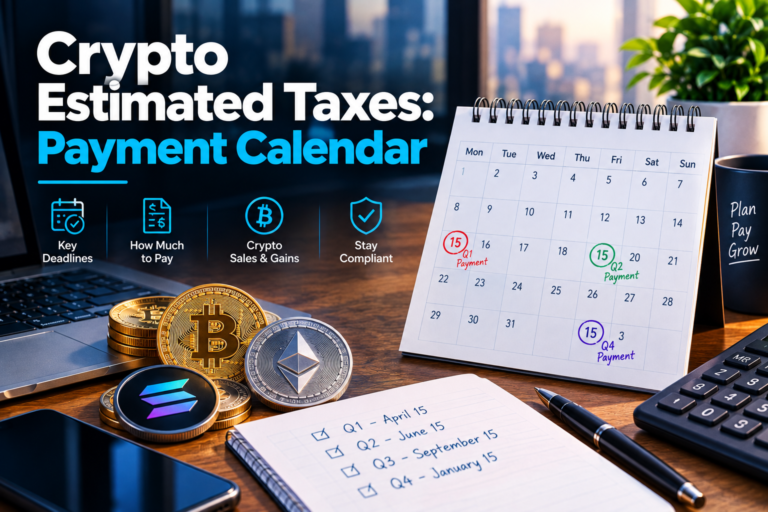
Crypto Trading Taxes 2026: What You Actually Report
Crypto trading taxes just got a new layer of complexity, and most traders haven’t caught up yet. Starting with the 2025 tax year, exchanges began reporting your activity directly to the IRS through a brand-new form. This guide breaks down exactly what gets reported, what still doesn’t, and the specific gaps that catch even experienced traders off guard.
The Basics: How Crypto Trading Taxes Actually Work
The IRS treats cryptocurrency as property, not currency. Because of this, nearly every crypto transaction is a taxable event, including trading one cryptocurrency for another, not just cashing out to dollars. If you held an asset for less than a year before selling, the IRS taxes any gain as ordinary income. Hold it longer than a year, and you qualify for lower long-term capital gains rates instead.
Meet Form 1099-DA: The New Reporting Requirement
For the 2025 tax year, filed in early 2026, exchanges like Coinbase and Kraken had to send you, and the IRS, a Form 1099-DA reporting your gross proceeds from crypto sales for the first time. However, this first version only reports proceeds, not your original cost basis. So, the responsibility for calculating your actual gain or loss still falls entirely on you.
That changes gradually. Starting with transactions made on or after January 1, 2026, brokers must also report cost basis, but only for what the IRS calls “covered securities.” This means assets you bought and held continuously at the same broker after that date. The first 1099-DA forms including basis data won’t arrive until early 2027.
The Basis Gap in Crypto Trading Taxes: A Real Risk Worth Understanding
Here’s the detail that catches people off guard. Say you bought Bitcoin on a hardware wallet years ago, then later moved it to an exchange to sell. That exchange often has no way to know your original purchase price. As a result, it may report a cost basis of zero to the IRS, even though you actually paid real money for that Bitcoin originally. If you don’t correct this on your own tax return using your own records, you could end up paying tax on the full sale price instead of just your actual gain.
What Form 1099-DA Doesn’t Cover
This is just as important as what it does cover. The form doesn’t report DeFi swaps, since Congress repealed a broader DeFi-specific reporting rule in 2025. It also doesn’t cover most NFT activity, staking rewards, or transfers between wallets you personally own. In other words, a significant chunk of genuine crypto activity simply doesn’t show up on this new form at all.
That said, this doesn’t mean that activity is tax-free. You’re still legally required to report all of it yourself, regardless of whether any exchange sends you a form. Receiving a 1099-DA is not a prerequisite for owing tax, and the absence of one doesn’t excuse unreported income.
Why the IRS Is Watching Crypto Trading Taxes More Closely Now
Brokers now send the IRS a copy of every 1099-DA they issue. Because of this, the agency can automatically match what you report against what your exchange reported. Mismatches between the two are exactly the kind of discrepancy that triggers additional scrutiny. So, if your exchange reports higher proceeds than what appears on your tax return, be ready to explain the difference with your own basis records.
What Active Traders Should Actually Do
First, keep your own detailed records of every purchase price, regardless of what your exchange eventually reports. If you’ve moved crypto between wallets or exchanges over the years, reconstruct that history now rather than waiting until filing season. Next, if you trade on decentralized exchanges, understand that this activity won’t appear on any 1099-DA at all. That means the recordkeeping burden falls entirely on you. We cover the broader trade-offs of DeFi trading in our guide to CEX vs. DEX.
Finally, consider using dedicated crypto tax software if you trade frequently or across multiple platforms. Reconciling stablecoin activity alone can involve matching hundreds of individual conversions against a single aggregated line on your form. Manual tracking gets unmanageable fast at any real trading volume.
What This Means If You’re Just Getting Started
If you’re new to trading, the good news is that starting now means building clean records from day one instead of reconstructing years of history later. Our step-by-step guide to starting crypto trading covers the basics of picking a platform and making your first trade. Our comparison of the best crypto trading platforms for US traders is worth reviewing with tax reporting in mind, since centralized platforms now handle more of this reporting automatically than decentralized ones ever will.
The Bottom Line on Crypto Trading Taxes in 2026
Crypto trading taxes in 2026 sit in an awkward transitional phase. Exchanges are reporting more to the IRS than ever before, but cost basis reporting remains incomplete for at least another filing season. Entire categories of activity, like DeFi trading and wallet transfers, still fall outside the system entirely. The safest approach treats every transaction as your own responsibility to track, regardless of what any exchange eventually reports on your behalf. For the official form details straight from the source, see the IRS’s page on Form 1099-DA.
FAQs
Do I owe taxes if I never received a Form 1099-DA?
Yes. You’re required to report all crypto activity regardless of whether an exchange sends you a tax form. Not receiving one doesn’t exempt you from reporting.
Does Form 1099-DA report my DeFi trades?
No. A broader DeFi-specific reporting rule was repealed by Congress in 2025, so decentralized exchange activity doesn’t appear on this form at all, even though it’s still taxable.
Why might my Form 1099-DA show a $0 cost basis?
If you transferred crypto to an exchange from a different wallet or platform, that exchange often has no record of your original purchase price and may report zero as a placeholder. You’ll need your own records to correct this on your tax return.
When does full cost basis reporting start?
Cost basis reporting begins for transactions made on or after January 1, 2026, but only for assets held continuously at the same broker. The first forms including this data will arrive in early 2027.