How to Choose a Crypto Exchange: 7 Things to Check
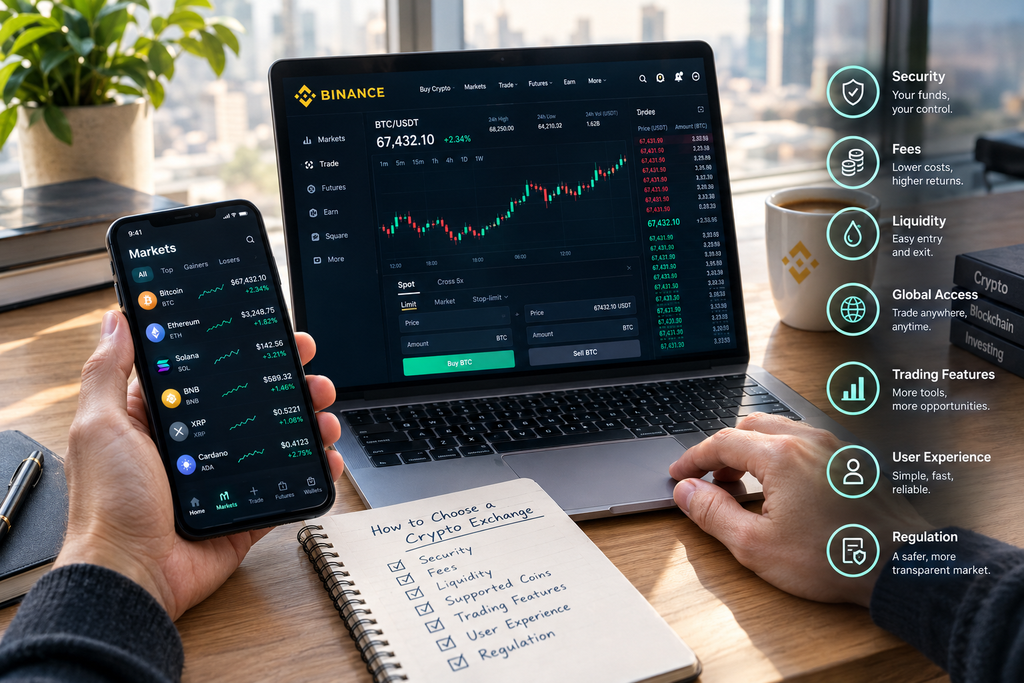
Signing up for a crypto exchange takes about five minutes. Fixing a bad choice can take years, or in the worst cases, cost you everything you deposited. So, learning how to choose a crypto exchange properly before you commit any real money is worth the extra ten minutes it takes to check these seven things first.
1. Confirm It’s Actually Available in Your State
This sounds obvious, but it trips up more people than you’d expect. A handful of platforms restrict access in certain states due to local licensing requirements, most commonly New York and Hawaii. Kraken, for example, isn’t available in Maine or New York at all. Before you go through a full sign-up and verification process, confirm the exchange actually operates where you live. Gemini, by contrast, holds a New York BitLicense and operates in all 50 states, which is worth knowing if you live somewhere with tighter restrictions. For official details on state-level crypto licensing, see New York’s Department of Financial Services BitLicense information.
2. Check the Exchange’s Security Track Record
Next, look at whether the exchange has ever lost customer funds to a hack. Kraken has never suffered a platform-wide breach resulting in stolen funds since its founding in 2011. Coinbase and Gemini have similarly strong records, though no exchange is entirely risk-free. We cover exactly why this history matters in our guide to what changed after the FTX collapse.
3. Look for Proof of Reserves, Not Just Marketing Promises
Since FTX, proof of reserves has become a genuine industry standard rather than a nice-to-have. Reputable exchanges now publish regular attestations, ideally verified by an outside accounting firm, showing that customer deposits are actually backed one-to-one. If an exchange doesn’t publish this kind of verification at all, treat that as a real warning sign, not a minor omission.
4. Read the Full Fee Schedule, Not Just the Headline Rate
A “0% trading fee” promotion rarely tells the whole story. Withdrawal fees, currency conversion spreads, and inactive account fees can add up quickly if you’re not paying attention. In addition, many exchanges charge noticeably more on their simple “beginner mode” than on their advanced trading interface. Before assuming an exchange is cheap, check its full fee page, not just the number in its ad.
5. Understand Exactly What Happens If the Exchange Fails
Ask directly: does this exchange carry any insurance covering crypto assets, separate from standard cash protections? Remember that crypto itself is never covered by FDIC insurance, regardless of what an exchange’s marketing might imply. Some platforms carry supplemental insurance on a portion of crypto holdings; others carry none at all. Knowing which category your exchange falls into before you deposit matters more than most people realize until it’s too late.
6. Check Coin Selection Against What You Actually Plan to Trade
It’s tempting to judge an exchange by how many coins it lists, but that number matters less than whether it lists the specific assets you actually want. Every major exchange covers Bitcoin, Ethereum, and the rest of the top 20 coins. The real difference shows up if you’re chasing newer or smaller-cap tokens, where some platforms list new assets far faster than others.
7. Test Customer Support Before You Actually Need It
Finally, check what happens when something goes wrong. Does the exchange offer live chat, phone support, or only a slow email ticket system? A strong help center matters far more at 11 p.m. on a Sunday when a deposit hasn’t shown up than it does during a smooth, uneventful week of trading. If possible, test the support channel with a simple question before you deposit any significant amount.
Putting It All Together
None of these seven checks takes more than a couple of minutes individually, but together they separate a genuinely solid exchange choice from one you might regret later. For a direct comparison of two platforms that consistently score well across most of these factors, see our guide to Coinbase vs. Kraken, and for a broader look at how exchanges function overall, our complete guide to how crypto exchanges work covers the fundamentals in more depth.
The Bottom Line
Learning how to choose a crypto exchange really comes down to verifying a handful of concrete facts rather than trusting an app’s polish or a friend’s recommendation. Check state availability, security history, proof of reserves, the real fee schedule, insurance coverage, coin selection, and customer support before you deposit anything. Doing this upfront takes minutes. Skipping it can cost you far more than that later.
FAQs
What’s the most important thing to check before choosing a crypto exchange?
Security track record and proof of reserves matter most, since they directly determine whether your funds are safe if something goes wrong with the platform itself.
Is it bad if an exchange doesn’t publish proof of reserves?
It’s a meaningful warning sign. Reputable exchanges increasingly publish regular, independently verified proof of reserves, and the absence of this is worth treating with real caution.
Does every crypto exchange work in every US state?
No. Some platforms restrict access in specific states, most commonly New York and Hawaii, due to local licensing requirements. Always confirm availability before signing up.
Should I choose an exchange based on how many coins it lists?
Not primarily. Focus on whether it lists the specific coins you actually plan to trade, since even smaller exchanges usually cover all major cryptocurrencies.