Grid Bots vs. AI Agents: What Actually Works
A trader recently documented spending $8,200 over four months testing automated crypto bots before switching approaches entirely. The problem wasn’t the bots themselves. It was that most of them were built on the same rigid logic that’s worked fine for years, right up until market conditions shifted. This guide breaks down the real, honest comparison between grid bots vs AI agents. Neither side of this debate is as simple as the marketing suggests.
Grid Bots vs. AI Agents: What Each One Actually Does
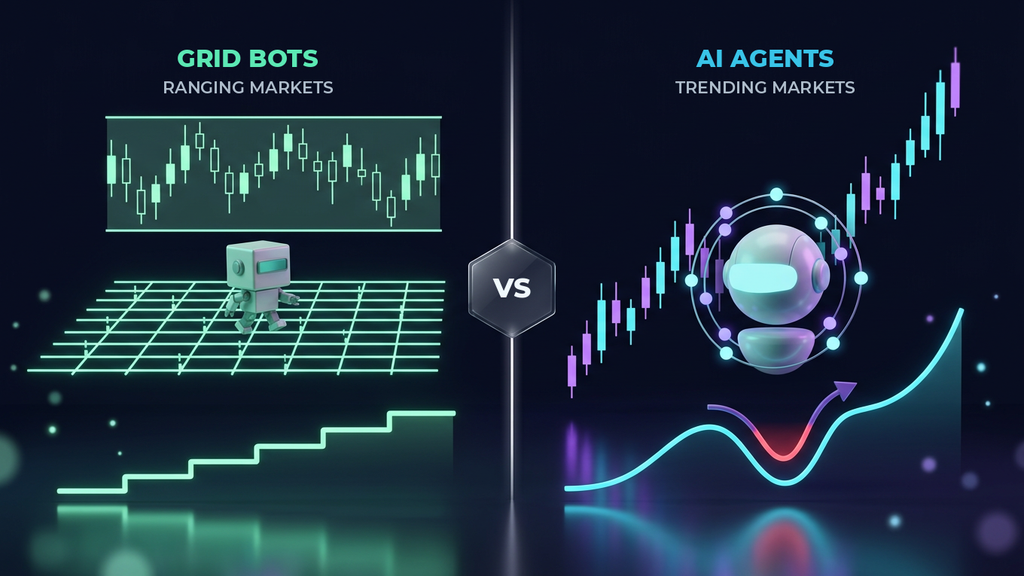
A grid trading bot places buy and sell orders at fixed price intervals within a set range, profiting from price oscillation back and forth inside that range. It’s a purely deterministic system. Given the same market input, it produces the same output every time. This isn’t a weakness by accident. It’s the entire point. Because a grid bot’s behavior is fully defined by its settings, you can backtest it against historical data and predict with real confidence how it will behave when similar conditions recur.
An AI trading agent works fundamentally differently. Instead of following fixed if-this-then-that logic, it perceives market conditions, reasons about what it’s seeing using statistical models or language models, plans a course of action, and learns from the outcomes of previous trades. The shift from bot to agent changes what you need to specify as a trader. With a bot, you write the exact rules. With an agent, you specify a goal and constraints instead, something like “manage risk within these boundaries,” and the agent figures out how to get there.
Where Grid Bots Genuinely Fail
The failure mode is structural, not a bug you can patch. Grid bots work well specifically when volatility stays inside a defined range. The moment a real trend develops and price breaks decisively out of that range, the bot doesn’t know to stop. It keeps buying dips on a trend that’s clearly breaking down, or keeps taking profit too early during a sustained rally it should have ridden longer. One trader testing 23 different platforms documented exactly this pattern: a legacy grid bot exited winning positions prematurely during a major trend, while a newer agent-based system kept adding to the position. The grid account finished down 6.2%. The agent-based account finished up 41.8%.
The Real Advantage: Recognizing When the Game Has Changed
This is where the grid bots vs AI agents comparison genuinely favors agents in specific conditions. A grid bot has no concept of “the market regime just changed.” An agent can recognize that a range-bound period has shifted into a genuine trend and adjust its behavior accordingly, rather than mechanically continuing to execute a strategy that no longer fits current conditions. That flexibility is exactly what separated the two accounts in the trend-following test above.
The Honest Downside Most Coverage Skips
Here’s what balanced analysis of this space consistently points out, and what most “AI beats old bots” articles conveniently leave out. A grid bot’s rigidity is also its biggest safety feature. Because its logic is fully inspectable, you know exactly what it will do before you risk real capital. An AI agent’s reasoning is comparatively opaque. You’re trusting a system whose decision-making process you can’t fully audit line by line, and that flexibility, the very thing that makes it valuable, is also what makes its failures harder to predict in advance.
Security risk compounds this concern. Chainalysis recorded roughly 158,000 personal wallet compromise incidents in 2025 alone, and every additional permission granted to autonomous software widens that attack surface further. Handing an AI agent direct wallet access and trading authority isn’t a purely theoretical risk. It’s a documented, growing one.
Even Sophisticated AI Agents Aren’t Immune to Losses
It’s worth remembering that intelligence doesn’t guarantee profitability. In one notable 2026 experiment we’ve covered elsewhere on this site, six advanced AI models given real capital to trade autonomously lost between 16% and 30.8% over the test period. Reasoning ability and consistent profitability are two genuinely different things, and conflating them is exactly how retail traders end up disappointed by tools marketed as a guaranteed edge.
Watch Out for This Specific Scam Pattern
The CFTC has issued explicit warnings about AI trading bot scams promising tens of thousands of percent in returns or claiming 100% win rates. Those specific claims are fraudulent, full stop. Legitimate research tools and trading frameworks are honest about their real limitations. Any platform guaranteeing outsized, risk-free returns through an “AI edge” deserves immediate skepticism, regardless of how sophisticated its marketing sounds.
The Grid Bots vs. AI Agents Workflow That Actually Holds Up in 2026
Rather than choosing one extreme or the other, the approach experienced traders increasingly use blends both tools deliberately. Use AI for context and pattern recognition across shifting conditions. Keep a human trader in the loop for final judgment on genuinely important decisions. Use rule-based bots specifically for execution tasks like stop losses and take-profit orders, where predictable, auditable behavior matters more than adaptive reasoning. Backtest everything before committing real capital, and set hard risk limits that no amount of AI confidence overrides. If you’re evaluating this space for the first time, our broader guide to crypto trading bots and whether they actually work covers the foundational questions worth answering before adding an AI layer on top.
How This Connects to the Broader AI Trading Shift
This grid-bot-versus-agent comparison sits inside a much larger transformation happening across the industry, which we cover in detail in our guide to AI trading co-pilots becoming the new standard. The direction of travel is clear. What matters is adopting these tools with realistic expectations rather than assuming either the old technology or the new one solves the problem entirely on its own.
The Bottom Line
Grid bots vs AI agents isn’t a contest with one clear winner. Grid bots offer predictability and auditability that genuinely matter, especially for well-defined execution tasks where you want to know exactly what will happen before it does. AI agents offer real adaptability to changing market conditions, at the cost of opacity and a documented, growing security risk when given too much autonomous authority. If you’re new to crypto trading entirely, our step-by-step guide to getting started is a better starting point than jumping straight into either automated approach. For the CFTC’s official guidance on identifying fraudulent trading bot claims, see the CFTC’s customer advisory on virtual currency trading.
FAQs
Are grid trading bots obsolete now that AI agents exist?
No. Grid bots remain useful specifically in range-bound markets and for execution tasks where predictable, auditable behavior matters more than adaptive reasoning.
Is it safer to use a rule-based bot or an AI trading agent?
Rule-based bots are more predictable and auditable since their logic is fully inspectable in advance. AI agents offer more adaptability but come with less transparency and a documented rise in wallet security incidents when given broad trading authority.
Do AI trading agents guarantee better returns than grid bots?
No. Even sophisticated AI models have shown real losses in live trading experiments, and any platform guaranteeing outsized or risk-free returns through AI should be treated with serious skepticism.
What’s the safest way to start using AI in crypto trading?
Start by using AI for research and context rather than full autonomous execution, keep hard risk limits in place, and never grant an AI agent more wallet permissions than a specific task genuinely requires.