Crypto Trading Bots 2026: Do They Actually Work?
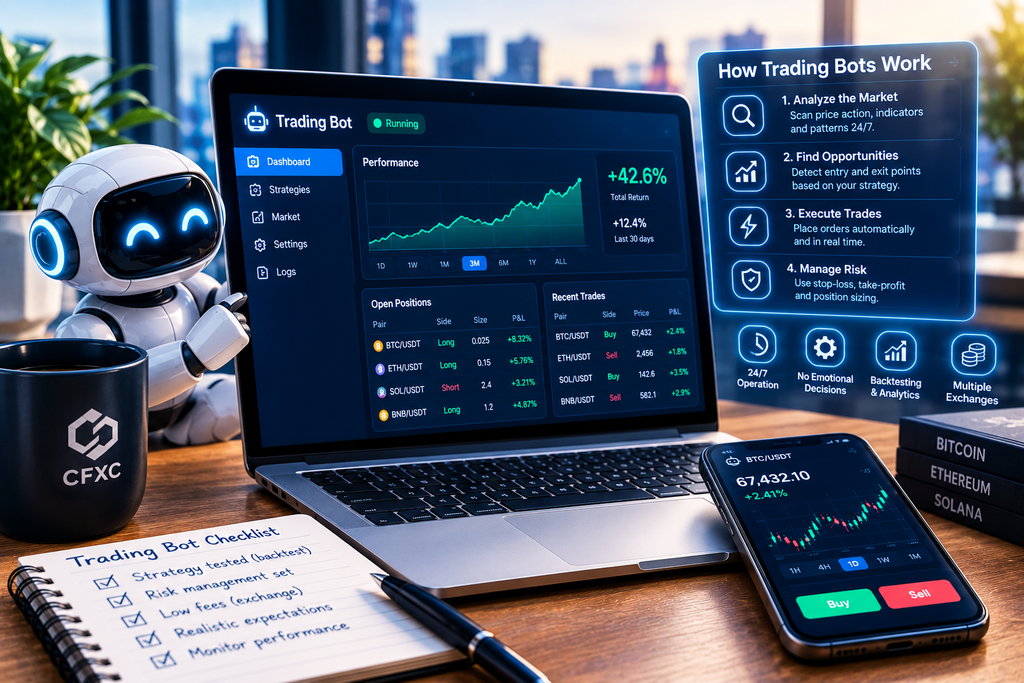
Every crypto cycle brings a fresh wave of hype around crypto trading bots, promising passive income while you sleep. So, do they actually work? The honest answer is more nuanced than either the marketing or the skeptics suggest. This guide breaks down how these bots really function, which strategies still hold up in 2026, and the warning signs that separate a legitimate tool from a scam.
What a Crypto Trading Bot Actually Does
At its core, a trading bot is software that connects to your exchange account through an API and executes trades automatically based on a set of rules. It watches market data, applies its programmed logic, and reacts faster than a human ever could. The “AI” layer marketed on top of many bots today usually adds pattern recognition or sentiment analysis, but the fundamentals remain the same. A bot automates a strategy. It doesn’t invent a winning one out of nothing.
Which Bot Strategies Still Work in 2026
Not every strategy holds up equally well. Arbitrage bots, which profit from price differences between exchanges, were genuinely lucrative between 2017 and 2019. However, those gaps have shrunk to fractions of a percent by 2026, and institutions with faster infrastructure now capture most of that opportunity before retail bots even react.
Grid trading bots, which place buy and sell orders at set intervals, work reasonably well in range-bound markets. That said, they perform badly in strongly trending markets, since the bot keeps buying as a price falls or selling as it rises. Because of this, grid bots only make sense if you have genuine reason to believe a market will stay range-bound, which is difficult to know in advance.
Trend-following bots represent one of the few areas where retail traders can still realistically compete, since large institutions often can’t move enough capital quickly enough to capture short-term directional moves the way a smaller bot can.
What About AI-Powered Trading Bots Specifically?
Here’s where expectations and reality diverge the most. Most consumer “AI bots” actually use fairly simple signal classification rather than sophisticated machine learning, regardless of how they’re marketed. The more advanced systems now use large language models to react to breaking news within seconds, an edge previously reserved for institutional trading desks.
That said, even genuinely advanced AI trading systems aren’t immune to losses. In one notable 2026 experiment, six advanced AI models given $10,000 each to trade autonomously on a prediction market lost between 16% and 30.8% of their capital. In other words, sophistication doesn’t guarantee profitability, whether the trader is human or artificial.
Security Risks That Have Nothing to Do With Strategy
Beyond whether a bot’s strategy works, security matters just as much. Bots need API keys to access your exchange account, and mishandled keys can expose your funds directly. As a result, always limit API permissions to trading only, disable withdrawal rights entirely, and restrict access to a single IP address where possible. Withdrawal allowlisting adds another layer of protection, ensuring that even a compromised API key can’t move funds anywhere except pre-approved addresses.
The Warning Signs of a Scam Bot
Scam bots remain a serious problem precisely because automation sounds like effortless passive income to people who don’t know how to evaluate the underlying code or statistics. Watch for these red flags before trusting any platform with your funds:
- Guarantees of fixed profits or “no losing trades,” which are simply impossible in real markets
- No visible drawdown data, which usually means losses are being hidden
- Backtested results with no live, out-of-sample performance history
- Vague “proprietary algorithm” language with no real technical explanation
- High-pressure sales tactics pushing you to deposit quickly
- Any request for direct custody of your funds rather than limited API access
A legitimate bot connects to your exchange account through restricted API access. It should never ask you to send funds directly to a wallet it controls.
So, Do Crypto Trading Bots Actually Work?
Used with a clear strategy and real risk management, bots can genuinely add consistency by removing emotional decision-making from trading. Approached as a “set it and forget it” path to guaranteed income, they will very likely cost you money instead. The traders who do well with bots in 2026 aren’t necessarily the ones using the most advanced technology. They’re the ones applying real risk discipline on top of it.
If you’re still building the fundamentals before automating anything, our step-by-step guide to starting crypto trading is a better starting point than jumping straight into bots. Once you’re comfortable trading manually, our comparison of the best crypto trading platforms for US traders covers which exchanges actually support the API access most legitimate bots require.
The Bottom Line
Crypto trading bots are legitimate tools, not money printers. They enforce discipline and remove emotion, but they don’t eliminate market risk, and no strategy works in every market condition. Before trusting any bot with real funds, paper-trade it first, verify its actual track record rather than a marketed backtest, and never hand over more account access than the bot genuinely needs to function. For official guidance on spotting automated trading scams, see the SEC’s investor alert on crypto trading bots.
FAQs
Can I actually make consistent money with crypto trading bots?
It’s possible with a sound strategy and proper risk management, but no bot guarantees consistent profit. Bots automate a strategy; they don’t create a winning one automatically.
Are crypto trading bots legal?
Yes, automated trading is legal in virtually all jurisdictions. Some specific practices, like market manipulation, remain illegal regardless of whether a human or a bot executes them.
Should I ever give a trading bot access to withdraw my funds?
No. A legitimate bot only needs trading permissions through your exchange’s API. Disable withdrawal rights entirely to protect your funds if the bot or its API key is ever compromised.
Do AI-powered trading bots outperform simple rule-based bots?
Not necessarily. Many “AI” bots use fairly basic pattern recognition despite the marketing, and even genuinely advanced AI systems have shown real losses in live trading experiments.