Fed Rate Decision: What It Means for Your Money
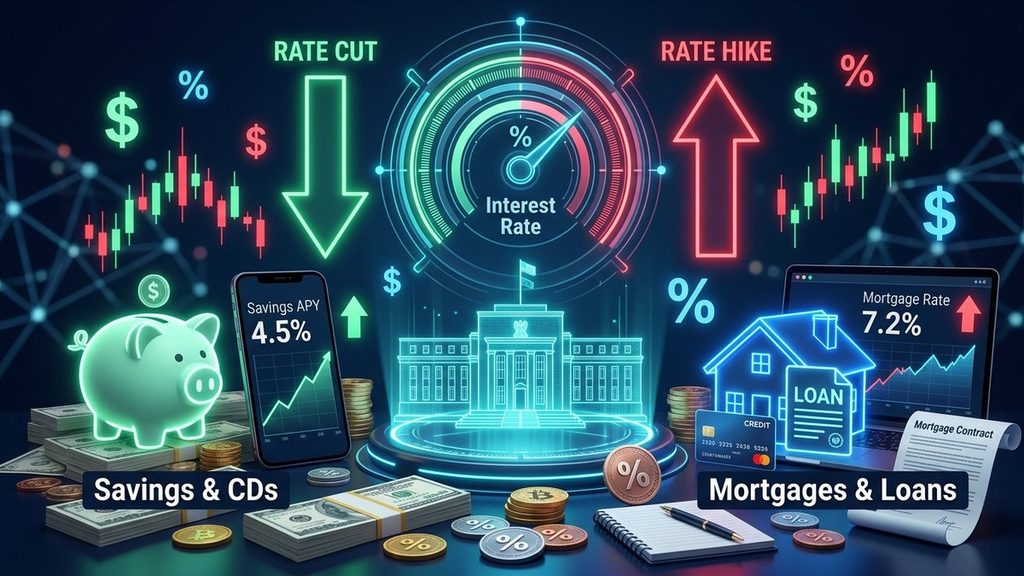
Tomorrow, the Federal Reserve announces its next Fed rate decision, and whatever it decides will ripple through your savings account and any loan you’re carrying within weeks. This isn’t a distant policy debate. It directly shapes what your bank pays you and what you pay a lender. This guide breaks down what’s actually at stake, no matter which way the decision goes.
Where Things Stand Right Now
The Fed cut its benchmark rate three times in late 2025, one quarter-point each in September, November, and December, landing the federal funds rate in a range of 3.50% to 3.75%. Since then, the Fed has held rates steady at every single meeting in 2026 so far. That’s five consecutive “no change” decisions. Tomorrow’s meeting could extend that streak, or it could break it in either direction.
What Happens to Your Savings in Each Scenario
High-yield savings account rates track the Fed’s benchmark closely, though not perfectly. Right now, the national average savings rate sits at a dismal 0.38% to 0.63%, while the best high-yield accounts pay 4% to 4.5% APY. If the Fed cuts rates tomorrow, expect banks offering the top yields to trim their rates within days, following the same pattern seen after each of last year’s three cuts. If the Fed holds steady, current top rates likely stay put, at least until the next meeting. A surprise hike, while unlikely given the current environment, would be the one scenario that could actually push savings yields higher.
What Happens to Your Credit Card and Loan Rates
Credit card APRs and personal loan rates respond to the same Fed rate decision, just in the opposite direction from your perspective. The average credit card APR already sits above 20%, and personal loans are projected to average around 12% for 2026. A rate cut would eventually nudge these down, though card issuers tend to pass along cuts slowly and often keep the bulk of the reduction for themselves. A hold means no immediate change to what you’re currently paying. If you’re already carrying a balance, our breakdown of credit card debt in 2026 covers the current rate environment and what to do about it regardless of tomorrow’s outcome.
Why You Shouldn’t Just Wait and See
Here’s the trap a lot of people fall into: waiting for a Fed decision before making any financial move. That’s usually the wrong instinct. If you’re carrying high-interest debt, the rates you’re paying right now are already elevated, and a single quarter-point Fed move won’t meaningfully change your situation either way. Our guide to the best balance transfer cards can help you act on that debt today instead of waiting on a decision you can’t control.
The same logic applies to savings. If you’re sitting in a low-yield account earning close to the 0.38% national average, moving to a high-yield account today captures the current rate regardless of what happens tomorrow. Waiting to see which way the Fed moves before switching accounts usually just costs you weeks of lost interest for no real benefit.
What to Actually Do Right Now
First, if you’re holding cash in a low-yield account, compare current high-yield savings offers today rather than waiting on tomorrow’s announcement. Second, if you’re carrying credit card or personal loan debt, focus on paying it down or transferring it to a 0% card now, since today’s elevated rates already justify action independent of tomorrow’s decision. Third, if you’re considering a CD, know that rates on shorter-term CDs have actually been climbing in recent months even as savings account rates drift down slightly, so locking in a competitive CD rate now could make sense if you’re expecting further cuts down the road.
The Bottom Line
Whatever the Fed decides tomorrow, the underlying math for your own finances doesn’t change dramatically overnight. Rates are elevated across the board right now, on both what you earn and what you pay, and that reality justifies action today rather than waiting on a single announcement. Use this Fed rate decision as a prompt to check your own accounts and rates, not as a reason to delay a move you already know makes sense. For the official announcement and the Fed’s own statement, see the Federal Reserve’s FOMC calendar and press releases.
FAQs
How often does the Federal Reserve meet to decide interest rates?
The Federal Open Market Committee meets eight times a year, roughly every six to eight weeks, to decide on the federal funds rate.
Does a Fed rate cut immediately lower my credit card APR?
Not immediately. Card issuers typically adjust rates within one to two billing cycles after a Fed move, and they don’t always pass along the full cut to cardholders.
Should I wait for the Fed’s decision before opening a high-yield savings account?
No. Waiting typically just costs you lost interest, since current top rates are available today regardless of what the Fed decides tomorrow.
What’s the current federal funds rate range?
As of September 2026, the federal funds rate sits in a range of 3.50% to 3.75%, following three cuts in late 2025 and no changes so far in 2026.