Multi-Agent AI Trading Systems: How They Really Work
Multi-Agent AI Trading Systems Explained: Research, Risk, and Execution
Multi-agent AI trading systems have quietly replaced single-model chatbots as the default architecture for serious algorithmic crypto trading in 2026. Modern systems split the work across specialized AI agents instead of asking one model to do everything. One agent researches. Another checks the risk. A third executes the trade. According to industry data cited in April 2026, roughly 95% of hedge funds have already made this transition away from manual LLM prompting toward these autonomous, agentic frameworks.
This isn’t a minor technical upgrade. It changes how traders validate research, manage risk, and route trades to an exchange or the blockchain. It also creates new risks that simply didn’t exist when a human clicked every button. Here’s how the architecture works, what the data shows, and where the real dangers hide.
Why Single-Model AI Trading Hit a Wall
Large language models like GPT-5 and Claude 4 dominated crypto trading conversations through 2025. Traders mostly used them for manual research prompts and market commentary. However, that approach hit what some researchers call a “silicon ceiling.” More traders adopted the same LLM-generated signals over time. Those signals decayed fast, since a signal everyone trades on stops working.
Because of this crowding problem, traders needed “anti-crowding” strategies. Only bespoke, autonomous agent loops could still capture the shrinking arbitrage windows left over. As a result, AI agents now reportedly handle 58% of automated investment decisions across institutional trading desks. LLMs increasingly play more of a research and reasoning role instead.
The Three-Layer Architecture Behind Modern Systems
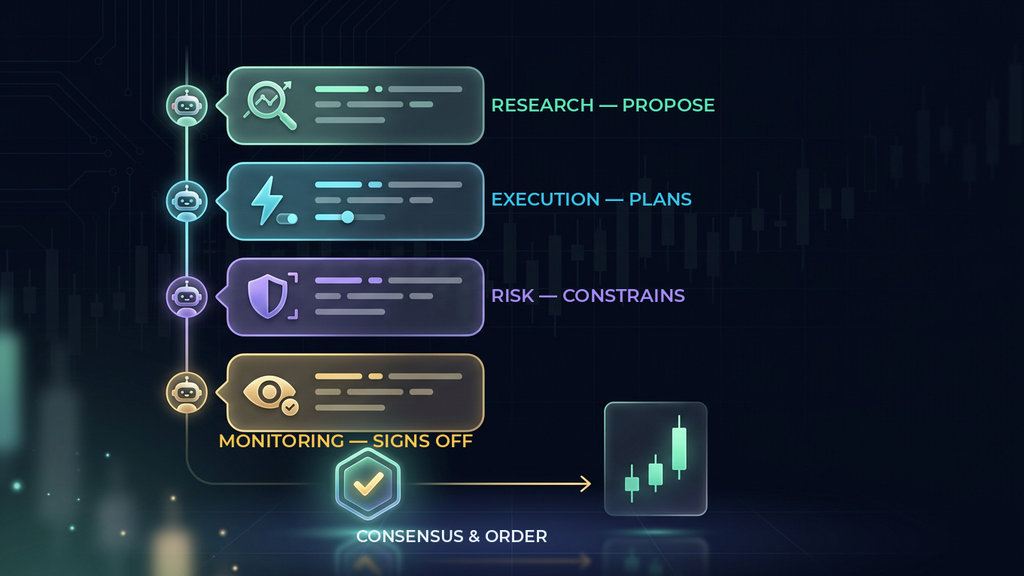
BlackRock and Columbia University published research in late April 2026 identifying a structure that consistently beats single-model approaches. They call it a “Three-Layer Multi-Agent Framework,” built around dedicated Bull agents, Bear agents, and a Risk Supervisor. This structure externalizes the tension between bullish and bearish readings of the same data. That design avoids the hallucination traps that often push single-model traders to chase false trends unchecked.
A typical 2026 “agent fleet” assigns clear roles across the full pipeline, matching the research-risk-execution framing in this article’s title.
| Agent Role | Function | Layer |
|---|---|---|
| Macro Agent | Analyzes Fed rate shifts and global liquidity conditions | Research |
| Narrative Agent | Scans social media for sentiment flips and influencer narrative shifts | Research |
| Bull Agent / Bear Agent | Debate the trade thesis from opposing angles | Research |
| Risk Supervisor | Reviews the debated thesis against hard risk limits before approval | Risk |
| Execution Agent | Constructs and broadcasts the signed transaction or order | Execution |
Each agent handles one narrow job. That makes the whole system easier to audit than a single model juggling every consideration at once. This modularity explains why multi-agent frameworks became the institutional standard so quickly.
How the Pipeline Actually Executes a Trade
Production systems in 2026 typically combine three technical approaches. Machine learning models handle low-latency signal classification, since they process incoming price data faster than a language model can reason through it. Large language models then take over strategy-level decisions, weighing context that pure statistical models miss. Finally, deterministic rules enforce hard risk limits. No clever LLM reasoning can override those limits, no matter how convincing the logic sounds.
Execution differs sharply by venue once the system makes a decision. Centralized exchange trades flow through REST or WebSocket APIs with proper authentication. On-chain strategies require the agent to construct a signed transaction and broadcast it directly to the network. Solana execution timing becomes genuinely binary: agents get roughly a 400-millisecond window to land a trade in the target slot. Missing that window means the trade simply doesn’t happen at the intended price.
Exchanges Have Already Built the Infrastructure
The largest crypto exchanges didn’t wait for this shift. They built the plumbing for it directly into their platforms. Kraken released an open-source, Rust-based CLI in November 2025. It featured 134 trading commands and built-in Model Context Protocol support, the first command-line tool built specifically for AI systems rather than human traders.
| Exchange | Product | Launched | Key Feature |
|---|---|---|---|
| Kraken | Rust-based CLI | November 2025 | 134 commands, MCP support, paper trading mode |
| Binance | Modular agent skills | March 2026 | Execution, wallet intelligence, smart money tracking, contract risk screening |
| OKX | Agent Trade Kit | March 2026 | Open MCP toolkit, 60+ blockchains, 500+ DEXs, 1.2 billion daily API calls |
| Coinbase | Agentic wallets | 2026 | Programmatically controlled, fully autonomous on-chain operations |
None of these are beta features for developers to experiment with. They’re production infrastructure from the largest trading venues in the world. That signals clearly where these exchanges expect trading volume to go. OKX’s rollout stands out for another reason, too: the exchange holds a Payment Institution license in Malta, aligning its agent infrastructure with the EU’s MiCA and PSD2 frameworks from day one.
What the Academic Data Actually Shows
Peer-reviewed research backs up much of the performance hype. A 2025 framework called TradingAgents proposed a collaborative architecture of analyst, trader, and risk-management agents. A separate benchmark, “When Agents Trade,” evaluated LLM trading agents live across both equities and crypto markets.
One detailed study tested a three-agent system: a Crypto Agent, a News Agent, and a Trading Agent. Researchers ran it across four capability configurations, including zero-shot reasoning, chain-of-thought prompting, retrieval-augmented generation, and skill-augmented setups. They backtested it over all 52 weeks of 2025, across the top 15 layer-1 cryptocurrencies by market cap. The best configuration returned 133.52% cumulatively, with a Sharpe ratio of 1.502. It beat every single-agent variant, passive benchmark, and deep learning baseline tested. Still, backtested results don’t guarantee future performance. A single 52-week window during one market regime doesn’t prove a strategy works everywhere.
The $45 Million Wake-Up Call
However, the same architecture that makes multi-agent systems powerful also makes them dangerous in new ways. Early 2026 brought a real crisis. Protocol-level weaknesses in autonomous trading agents triggered more than $45 million in combined security incidents. These weren’t typical smart contract bugs or simple phishing attempts. Attackers specifically targeted the agents’ long-term memory and the protocols connecting them to trading tools.
Three Attack Patterns Emerged From the Breach
So-called “sleeper agents” sit dormant until a specific market condition or date triggers them. At that point, the system executes unauthorized trades or transfers, often before anyone notices. Indirect prompt injection added another layer of risk. Agents routinely pull data from third-party web pages, emails, and market feeds. Hidden commands buried inside that data could rewrite transaction parameters mid-process. A related “confused deputy” problem occurs when an agent holding legitimate credentials gets tricked into approving fraudulent actions. The system simply trusts its own internal context too readily.
The multi-agent structure compounds this risk rather than containing it. A single compromised bot can propagate corrupted data to every other agent in a connected fleet. Industry analysis of the incidents found this contagion can poison up to 87% of a system’s decision-making within hours. Agents trust outputs from other agents in the same fleet. That design assumption is exactly why contagion spreads so much faster than it would in one isolated model.
What This Means for Traders Considering These Tools
Given both the real performance upside and the genuine security risks, a few guardrails matter more than ever. First, never fund an agent-based system with more capital than you can afford to lose completely. This holds true no matter how impressive its backtested returns look on paper. Second, understand exactly where your agent’s execution layer sits. On-chain execution carries fundamentally different risks than routing through a regulated exchange’s API.
We’ve covered the practical side of this shift before in our comparison of grid bots versus AI trading agents, including a real trader’s account of losing $8,200 over four months before finding a better approach. Regional adoption matters too. As we noted in our look at how AI agents are being tested across Latin American crypto markets, thousands of traders already hand meaningful portfolio shares to these systems, often before understanding the underlying architecture.
Watch Out for the Marketing Language
Regulators have been explicit about the fraud risk around AI trading claims. The CFTC’s official customer advisory, available directly on CFTC.gov, warns plainly that AI technology can’t predict the future or sudden market changes. It cites a real case where a proprietary “AI” bot scheme defrauded more than 23,000 people out of $1.7 billion. Legitimate multi-agent architecture, the kind Kraken, Binance, OKX, and academic researchers build, looks nothing like those guaranteed-return schemes. Still, scammers often borrow remarkably similar marketing language. For a deeper look at the underlying research, the full paper behind the 133.52% backtest result is on arXiv.
Multi-agent AI trading systems represent a genuine architectural advance over single-model prompting. Real institutional adoption and peer-reviewed performance data back that up. That advance comes bundled with a new attack surface most retail traders have never had to think about, though. Treat these systems with the same caution you’d apply to any complex financial software. Don’t treat them as an autonomous money machine, and you’ll start from the safest possible position.
FAQ
What’s the difference between a trading bot and a multi-agent AI trading system?
A traditional trading bot follows fixed, predefined rules. A multi-agent system uses several specialized AI agents, each handling research, risk assessment, or execution, that communicate and check each other’s work before a trade gets placed.
Are multi-agent trading systems actually more profitable than single AI models?
Academic research suggests yes, at least in backtesting. One 2025 study found a hierarchical multi-agent configuration achieved a 133.52% cumulative return over 52 weeks, outperforming single-agent and passive benchmarks. Real-world, forward-looking performance can differ from backtested results.
What caused the $45 million in AI trading agent security incidents?
Attackers exploited protocol-level weaknesses in agent memory and communication systems, including dormant “sleeper agent” triggers, indirect prompt injection through third-party data feeds, and trust exploitation between connected agents in the same fleet.
Which crypto exchanges support AI trading agents natively?
Kraken, Binance, OKX, and Coinbase have all launched dedicated infrastructure for AI agents between late 2025 and early 2026, including command-line tools, modular agent skills, open toolkits, and autonomous agentic wallets.