Crypto Risk Appetite Memecoins: Why Traders Are Back
Crypto Risk Appetite Is Rising: Inside the Shift Toward Memecoins
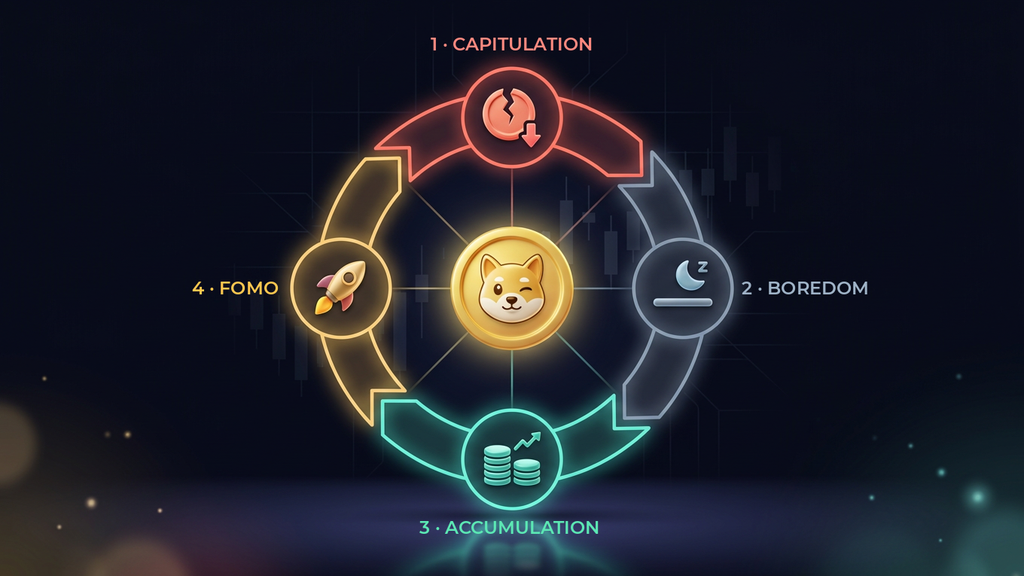
Crypto risk appetite memecoins data tells a clear story in 2026: speculative trading came back from the dead, and it came back fast. After bottoming out in December 2025 at its lowest level ever recorded, the meme coin sector staged one of the sharpest recoveries in its history. Trading volume didn’t just recover, it tripled within days. That kind of move signals something bigger than one lucky rally. It signals that traders have decided the market is safe enough to gamble in again.
This matters beyond meme coins themselves. Historically, speculative sectors like this one tend to move first when broader risk appetite shifts. When traders rotate into low-utility, high-volatility assets, it usually means confidence is rebuilding across the entire crypto market, not just in one narrow corner of it.
How Bad Things Got Before They Turned Around
By late December 2025, the meme coin sector had been thoroughly beaten down. Market cap had crashed 65% from its 2024 peak, settling at a low of roughly $35 billion. Meme coin dominance, meaning its share of the total altcoin market, fell to just 3.2%, down from 11% in November 2024. That was the lowest reading on record, according to CryptoQuant data. Daily trading volume had dried up to only $2.17 billion.
Then, starting January 3, 2026, everything flipped. Trading volume surged from $2.17 billion to $8.7 billion within days, a 300% jump that confirmed this wasn’t just one isolated pump. Analysts compared it to Q3 2024, when a similarly flat, quiet period preceded the strongest meme rally in the sector’s history. Dogecoin gained 20% that week. Shiba Inu added nearly 19%. Pepe jumped 65% on its own.
The table below shows just how dramatic the swing actually was.
| Metric | Late December 2025 | Early January 2026 | Mid-September 2026 |
|---|---|---|---|
| Meme sector market cap | ~$35 billion | ~$47.7 billion | ~$32–38 billion |
| Daily trading volume | ~$2.17 billion | ~$8.7–9.2 billion | Varies by token, still elevated |
| Meme coin dominance (share of altcoins) | 3.2% (record low) | Recovering sharply | Stabilized, no longer at record low |
Fuentes: CryptoQuant, CoinGecko, BeInCrypto, MEXC Research (ver notas de implementación).
Why Traders Rotated Into Risk in the First Place
Because Bitcoin and Ethereum both stalled through late 2025, traders looking for volatility had nowhere obvious to turn. When large-cap assets consolidate for weeks at a time, capital doesn’t just sit still. It looks for action elsewhere. Meme coins, with their extreme price swings and low barriers to entry, fit that need perfectly.
Social sentiment amplified the move considerably. Influencer predictions, including trader James Wynn’s bold call that PEPE could reach a $69 billion market cap, spread fast across social feeds. Community chatter intensified, FOMO fed on itself, and billions of dollars flowed into the sector within days. Meanwhile, Base creator Jesse Pollak added a cultural argument to the mix, describing memecoins as a fundamental part of on-chain culture rather than a passing gimmick, a view that resonated with traders looking to justify the rally beyond pure speculation.
As a result, by January 5, 2026, the sector’s total market cap had climbed past $47 billion, a 7% jump in just 24 hours. Individual coins told the more dramatic story: PEPE alone had jumped roughly 70% in the first week of the year.
Robinhood Chain Has Become a Memecoin Trading Hotspot
One of the more surprising 2026 developments is how much memecoin activity has concentrated on Robinhood Chain, a network built using Arbitrum’s underlying technology. In early September, its daily transaction fees reached $6.04 million, driven heavily by memecoin trading, new token launches, and DEX volume on platforms like Uniswap.
This growth hasn’t come without friction. A public dispute broke out between the co-founders of Arbitrum and Solana over how Robinhood Chain splits its protocol revenue. Under the current arrangement, Robinhood Chain keeps around 90% of net protocol revenue, sharing only 10% with the Arbitrum DAO. Because so much of that revenue traces back to memecoin speculation, the disagreement highlights just how central meme trading has become to newer blockchain economics.
A particularly unusual trading pattern emerged on the chain, too. Traders began buying tokenized stock assets before purchasing certain meme coins, effectively locking stock tokens inside liquidity pools to access better pricing. This created real weekend scarcity and unpredictable price swings. MEME/AMC trading pairs alone generated $73.5 million in 24-hour volume during one particularly active stretch in early September. However, sustainability questions are already surfacing, since Robinhood’s gas fee subsidy on the chain is scheduled to expire on September 29, 2026. Once that subsidy disappears, some of this activity may cool off considerably.
A Single Trade Can Still Change Someone’s Life (or Wipe Them Out)
The sector’s viral potential remains extreme. On September 4, 2026, a token called MEME, launched through the Pump.fun platform on Solana, surged over 500,000% in a single day, briefly touching a market cap above $250 million. One trader reportedly turned a $2,972 position into $2.1 million from that single move. Stories like this drive plenty of new entrants into the space, but for every documented winner, there are far more traders who bought after the spike and got stuck holding worthless tokens once attention moved elsewhere.
Where the Meme Sector Stands Today
As of mid-September 2026, the total meme coin market cap sits somewhere between $32 billion and $38 billion, depending on which tracker and which day you check, reflecting how quickly this figure still moves week to week. Dogecoin remains the sector’s undisputed blue chip, still commanding the deepest liquidity by a wide margin.
| Coin | Price (approx.) | Market Cap (approx.) | 24h Volume (approx.) |
|---|---|---|---|
| Dogecoin (DOGE) | $0.125 | $18.1 billion | $417 million |
| Shiba Inu (SHIB) | $0.0000173 | $10.2 billion | $157 million |
| Pepe (PEPE) | $0.0000113 | $4.76 billion | $498 million |
| dogwifhat (WIF) | $2.20 | $2.19 billion | $472 million |
| FLOKI | $0.000184 | $1.78 billion | $378 million |
Fuente: CoinGecko, snapshot de mediados de septiembre 2026. Estas cifras cambian constantemente; verifica los datos en vivo antes de tomar decisiones.
Dogecoin’s staying power comes largely from age and liquidity rather than any new development. It has survived 12-plus years and multiple full bear markets, giving it a track record that newer tokens simply can’t match yet. Pepe, meanwhile, continues to show the strongest whale sensitivity in the sector, meaning large holders moving in or out tend to trigger outsized price swings across the whole meme category.
What This Means for Regulation and Risk
It’s worth understanding exactly what legal protection you do and don’t have when trading these assets. On February 27, 2025, the SEC’s Division of Corporation Finance issued a staff statement concluding that meme coins generally don’t qualify as securities under federal law. Because they don’t generate yield or convey rights to future income, the Division compared them to collectibles rather than investments.
That conclusion carries a serious practical consequence. Since meme coins fall outside securities law, neither purchasers nor holders receive the investor protections that normally apply to registered securities. In other words, if a meme coin project turns out to be fraudulent or simply collapses, you generally have far less legal recourse than you would with a traditional investment. This isn’t a minor technicality. It’s the core reason financial educators consistently recommend capping meme coin exposure to a small slice of any portfolio, typically no more than 5% to 10% of total crypto holdings.
How to Approach Rising Risk Appetite Without Getting Burned
Given the sector’s documented volatility, a few practical guardrails go a long way. First, treat any meme allocation as a small, clearly defined sleeve of your portfolio rather than a core holding, and resist the urge to expand that allocation just because one position is winning. Second, if you’re using automated trading tools, remember that meme coin price ranges shift constantly, so a strategy that worked in one month can whipsaw badly just weeks later. We cover this exact challenge in more depth in our comparison of grid bots versus AI trading agents, including one trader’s real $8,200 tuition bill learning that lesson the hard way.
It also helps to understand why capital rotates into meme coins in the first place. As we discussed in our recent look at Bitcoin’s $80,000 support level, when major assets consolidate for extended periods, traders often look elsewhere for volatility, and meme coins are usually the first place that capital lands. Understanding that pattern can help you anticipate rotation before it happens rather than chasing it after the fact.
For the SEC’s full staff position on how meme coins are treated under federal securities law, the official statement is available on SEC.gov. Ultimately, rising risk appetite isn’t inherently good or bad. It’s simply a signal. What you do with that signal, and how much of your portfolio you’re willing to risk chasing it, determines whether you end up as the trader who turned $2,972 into $2.1 million, or the one left holding the bag once the next narrative takes over.
FAQ
Are meme coins protected by the SEC like stocks are?
No. The SEC’s Division of Corporation Finance stated in February 2025 that meme coins generally don’t qualify as securities, which means holders don’t receive federal securities law protections.
What triggered the January 2026 memecoin rally?
Bitcoin and Ethereum both stalled through late 2025, pushing traders to look elsewhere for volatility. Combined with viral influencer predictions and social media momentum, this drove a 300% jump in daily trading volume within days.
Is Dogecoin still the biggest meme coin?
Yes. Dogecoin remains the largest meme coin by market capitalization, benefiting from the deepest liquidity in the sector and a 12-plus year track record across multiple market cycles.
How much of my portfolio should go into meme coins?
Financial educators commonly suggest capping speculative meme coin exposure at 5% to 10% of your total crypto portfolio, given the sector’s extreme volatility and lack of regulatory protection.